


IN.SE.CON 2026 Congress: a record-breaking event and a shared agenda for national digital sovereignty
For two days, Poznań was the venue for important debates on digital security. The third edition of the IN.SE.CON International Congress on Cybersecurity and Breakthrough Technologies confirmed that discussions on national cyber resilience, breakthrough technologies, and digital sovereignty have taken on a strategic dimension today.
This year’s edition—co-organized by the Ministry of National Defense and the MTP Group—set new records in every respect: a larger number of participants, twice as many exhibitors, and a significantly expanded EXPO area.
National security as a shared responsibility
IN.SE.CON has solidified its position as one of the key events dedicated to digital security in Central Europe. Representatives of military command, government and local administration, the private sector, the scientific community, and technical experts gathered at the Poznań Congress Center. As Filip Bittner, Vice President of the MTP Group, emphasized during the opening, there are good reasons to be satisfied—the event, launched three years ago, has been steadily growing in strength and attracting visitors from many countries who come to exchange experiences and learn about the latest technologies.
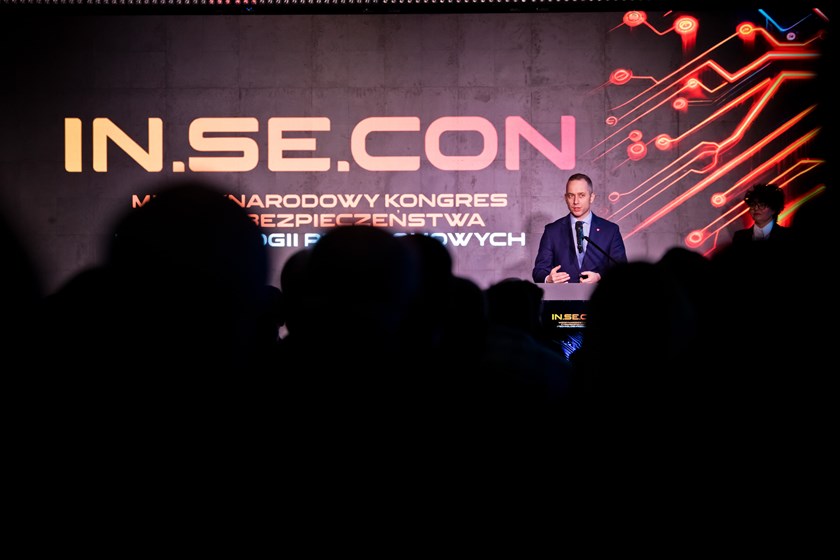
Cezary Tomczyk, Deputy Minister of National Defense, noted that national security is today the “highest priority” and requires close cooperation between the military, the government, and industry. In turn, Deputy Prime Minister and Minister of Digital Affairs Krzysztof Gawkowski emphasized in his lecture: Cybersecurity and breakthrough technologies go hand in hand in the fight for a secure future. There can be no strong, sovereign state without the ability to understand how the technological and networked reality is changing. He also noted that digital warfare often takes place away from the spotlight—through disinformation campaigns, the use of artificial intelligence as a force multiplier, deepfakes, or precisely targeted phishing attacks.
Three stages. One agenda – digital security
The congress program took place simultaneously on three stages, forming a cohesive, multidimensional agenda.
The Main Stage served as a space for strategic debate. Discussions focused on breakthrough technologies in the new type of warfare of the 21st century, sovereign AI for Poland, cooperation within NATO, and the role of human capital in building national resilience. A debate on military-industry cooperation featuring representatives of global technology companies drew significant interest, and the conversation with Dr. Sławosz Uznański-Wiśniewski became one of the most inspiring moments of the first day.
The Business and Local Government Stage focused on the practical aspects of regulation and risk management. Discussions covered challenges related to the NIS2 and CER directives, ISAC cooperation models in the water supply sector, cyber resilience of cities, and the responsible implementation of AI-based solutions. It was clearly emphasized that formal compliance with regulations is just the starting point, and true resilience requires a lasting change in organizational approach.
Insights from practitioners: the professionals’ stage and call for papers
A new feature of this year’s edition was the expanded Professionals’ Stage, dedicated to SOC, CSIRT, and CERT teams, Red and Blue Team specialists, analysts, and penetration testers. In three thematic blocks—prevention, active defense, and crisis management—topics discussed included the use of MITRE ATT&CK, full attack chain analysis in IoT environments, XDR systems, and detection based on Windows registry artifacts.

The program for this stage—like most of the Business and Local Government Stage program—was developed based on a Call for Papers. The organizers’ intention was to give a voice to practitioners who deal with real-world challenges on a daily basis and wish to share their experiences. Submissions were evaluated by a Program Council composed of experienced experts who fully understood what kind of knowledge participants actually seek in conference programs. As a result, the agenda had a distinctly practical, operational focus.
Technologies of the future and a space for innovators
An integral part of the event was the expansive EXPO zone, where partners presented solutions supporting the security of the digital infrastructure of the state and organizations. A new startup space enabled young companies to engage in direct dialogue with representatives of the government and the defense sector.

Participants also had the opportunity to test their skills at CyberHackLab—an interactive zone where theory met practice through tasks inspired by real-world incidents.
The third edition of IN.SE.CON confirmed that digital security is today a shared responsibility of government, the military, business, and the expert community. Poznań once again became a place where strategic decisions, operational experience, and innovative solutions converge toward a single goal—building national resilience in the era of technological transformation.
We thank all participants, partners, and speakers for joining us—and we’d like to invite you today to the next edition of IN.SE.CON in April 2027!